Showing posts with label Model Railway. Show all posts

Saturday, January 7, 2023

Welcome to Lime Works

Welcome to Lime Works. 

This is the first in a series of posts on the construction of my new HO scale micro switching layout, Lime Works.

The planning

During last years lockdown I decided to build a micro layout using only the resources and materials I already had. I kept working through lockdown and other than a bit of planning this project got no further.

During this planning phase I found a plan from Peco - Peco Setrack OO Plan 30 Locotec and Dewsbury Cement Terminal. This plan is for a OO scale minimum space micro switching layout.

Drawing of the Peco Setrack OO Plan 30 Locotec and Dewsbury Cement Terminal.

Track plan for the Peco Setrack OO Plan 30 Locotec and Dewsbury Cement Terminal.


For some reason this plan has always caught my interest. As well as the plan and drawing, Peco supplied a short description for this layout as well.  

Baseboard Space Required - 122cm x 30cm (4'x1')

This is a basic design that can be used in two ways, both reflecting the prototype at Dewsbury Blue Circle cement terminal and Locotec.

First you can treat both the left-hand sidings as part of the terminal and shunt PCA wagons (Hornby) accordingly. Second, you could use the rear siding, left-hand side as the maintenance shed for Locotec, justifying the appearance of many different shunters. In both cases the right-hand end goods shed can receive single wagons carrying equipment or materials. A Peco SL-43 Loco Lift can be used as a short cassette to place and remove rolling stock inside the rear lean-to shed, having first created a suitable access hole in the backscene.

Not a large layout, but one that can be thoroughly detailed and extended when resources permit. (Peco Publications).

While this is a very simple track plan, it would give me the opportunity to work through all the different facets of constructing a model railway - baseboards, track laying, wiring for DCC, back boards, kit building, scratch building and scenery - in a short time.

I'm also a big fan of shunting locomotives and industrial buildings and sidings which this plan is ideally suited for. Because I already have some HO scale Australian V/Line T and Y class locomotives and wagons, the layout would be set in 1980's Victoria.

To further seal the deal I already had a simple 120cm x 30cm baseboard constructed for another project that never passed the plywood phase.

So the decision has been made to build this micro switching layout!

While the Peco plan is for a cement terminal I'd like to model a lime works such as the ones at Makareao and Weston in North Otago. These would fit in well with the Peco plan.

The Limeworks at Makareao sometime in 1984 or 1985. Photo by Richard Emerson from the Ghost Railways of Otago Facebook page. You can visit the page here

Next up in the series I'll show how I built the baseboard, laid the trackwork and burnt my fingers with a soldering iron as I attempted the wiring.

Ma te wa!


Saturday, January 1, 2022

Magazine Round Up - Summer 2021.


Welcome to the Summer 2021 magazine round up. I've got my standard three essential magazines that I have happily read with a beer in the summer sun.


First up is the September 2021 edition of the NZ Model Railway Journal. Now I know what you might be thinking, this is the September Issue. Yes, yes it is. Unfortunately I haven't been able to get the December issue of this excellent magazine. 

The September Journal has an excellent range of articles and pictorials with a focus on way and works rolling stock. The journal includes articles on building a simple jig for soldering wires by Les Downey, basic benchwork using plywood by Peter Ross, a decoder tester, a stunning fell engine built using a 3D printed body by Karl Shields, an early way and works train at Little River, E class tank wagons and three on building E wagons. The magazine also has three pictorials including photos of a beautiful WA tank locomotive by Bryan Lawrence, a 50's focus on steam fell locomotive H 201 working on the famous Rimutaka Incline and vehicle views of non-revenue wagons in the 1950's and 70's.

I'll get the journal into the right order in the Autumn magazine round up.


Next up is the December 2021 edition of the Australian Model Railway Magazine. Another great magazine and this one is packed with great articles and photo's.

The December issue covers the late Rob Burford's triple-gauge South Australian layout Pirie, kit bashing a NSW Countrylink RDH coach, part 3 of Chris Jones's excellent Modelling Modern-era Containers, a look at the Logan District Model Railway Clubs brilliant layout of Wallon in HOn3 1/2, an excellent article by Michael Baum on Micro Layouts and painting realistic backdrops using spray paints.

The stand out for me was Michael Baum's article on micro layouts. I'm a big fan of micro layouts as they're a great way to develop your skills in a small space.


Last but not least is the summer edition of The Linesider. This relatively new magazine continues to get better and better. Like the the journal this edition has a focus on way and works on New Zealand's rail network. It's good to see this normally unseen work being covered. Normally the locomotives and rolling stock get all the love, but they aren't going anywhere without the hard work of the gangers.

Articles in the December edition include a fascinating article by Rob Webb called trackwork for beginners. Definitely the highlight for me. Other articles cover the end of NZR steam, the Kingston Flyer, a nostalgic look at the old Rails magazine, the Silver Star, Railcar Classroom and a short story by Max Kennelly with Bill Cowan recalling a stormy trip from Dunedin to Oamaru in 1975. 

There is also a good pictorial by D.L.A Turner documenting the running of the Kapiti Family Express hauled by JA 1271 and DA 1431 from Paraparaumu to Paekakariki and back on the 30th of May 2021.

Another interesting story was the purchase of 57 new locomotives for the South Island. The new dual cab, low emission diesel locomotives will be built by Stadler Rail Valencia from Spain and will replace the aging South Island fleet of DC, DFT and DX locomotives. This is big news for the South Island and something I might cover in a dedicated post later on in the year.

And that's about it.


Friday, August 20, 2021

Lock Down Layout - Part 1 The Plan

With our sudden move to Alert Level 4 lock down and the opportunity to 'work' from home I thought now might be a good time to build a small lockdown micro layout. 

Since all my loco's are DCC I was going to put together a short programming track but why not make it into a proper layout. I've never built a layout to the scenicing stage. This will give me a great opportunity to practice all the different facets of model railways - bench work, track laying, DCC wiring, structure building and scenicing. Also by finishing a micro layout my wife will stop accusing me of buying stuff and not finishing anything.

The only downside is that I can only use what I have in the shed. 

A short internet search found a great plan that would work well as a micro layout, The track plan is Peco's Setrack OO Plan 30 - Locotec and Dewsbury Cement Terminal.


This plan is pretty simple and with a main and a single point leading to a siding. The original plan depicts a cement plant on the right hand side which can be shunted using both sidings and a goods shed on the right hand side that would receive wagons carrying machinery and other materials. At 122cm by 30cm (4' x 1') this is a good little layout that could be built fairly quickly.


I didn't have to look to far to find a Victorian prototype that would work with this plan. During my trip to Melbourne in 2016 I visited the Allied Flour Mill siding at Kensington. This is one of the last examples of broad gauge trains serving a Melbourne industry. 

I found some photos that I took on my visit in 2016 showing the mill. 


Unfortunately when I visited there was no train in the siding. So I had to search online to find these great photos of Kensington on the Wongm's Rail Gallery website. This is great resource of photos from around Melbourne and Victoria. You can find the Wongm's Rail Gallery website here.


The siding has a simple unloading operation. A loaded grain train arrives and starts to unload the first two wagons using an under track auger. When the first two wagons are unloaded the locomotive pulls the train forward positioning the second two loaded wagons over the auger. As these wagons start to unload the locomotive and first two now empty wagons cut off the train and move up the back shunt clear of the points. The points are set for the other siding and the loco pushes the two wagons back. The loco then cuts off the empty wagons and returns up the back shunt. The points are reset and the loco moves back onto the train. The train is again pulled forward with the third two wagons positioned above the auger for unloading. The loco and the second two now empty wagons are cut off before moving up the backshunt. This shunting sequence continues until all the wagons have been unloaded. 

A youtube video of the Kensington grain train shunting the flour mill siding can be found here

So the plan I have is something like this...


The layout differs from the siding at Kensington because it has a right hand point and not a left hand one. This is because I can only find a spare right hand point.. If I can find a left hand point I will use that to match the real thing.

And that's about it.


Saturday, July 24, 2021

Model Railway Show: Alpine Energy Model Railway Expo, Timaru

The OO9 Scale Saxford Light Railway.

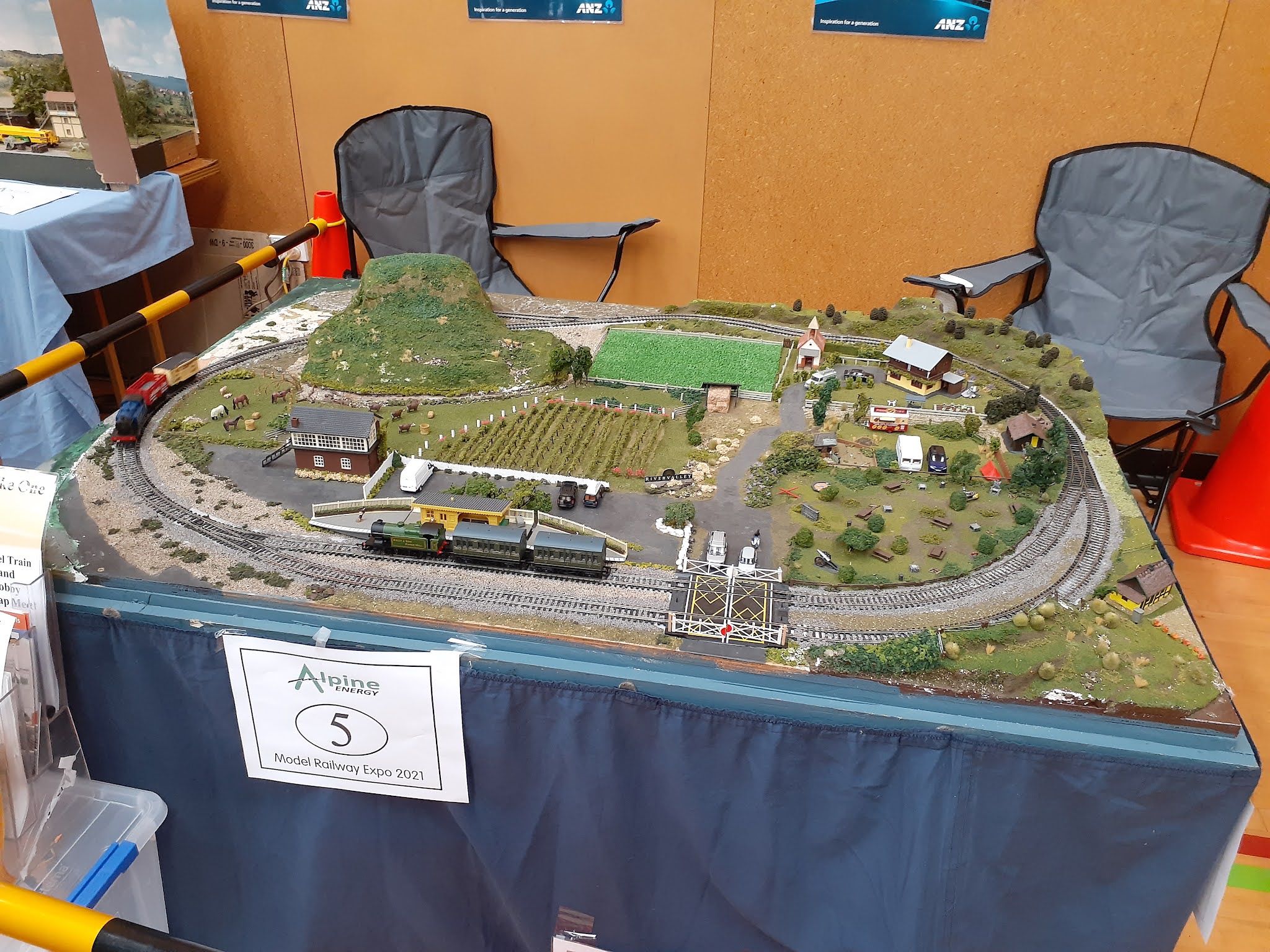
Last Saturday I managed to get to Timaru to visit the Alpine Energy Railway Expo. The show was held at Roncalli College Gymnasium. 

This was my first time going to this show and it was definitely worth the drive. There were 18 layouts on show with a mix of N, American and European HO, OO9, OO, G, large scale and even a huge Tomy Trains layout. All the layouts were great and built to a high standard.

The freelance scale HO scale Zealandia. This layout is based on a riverport in New Zealand and is set in the 1950's. 

This show is also a fundraiser for Hospice South Canterbury and last year raised $2500 for the hospice. A great effort by the organisers.

A train on the Christchurch Garden Railway Group's G scale floor layout.

Montigy is an HO scale French layout that is operated using digital control via a tablet.

040 Trains and Models from Ashburton and Toot Toot Trains from Invercargill had stalls at the show and looked to be doing some good business. You can find the websites for 040 trains here and for Toot Toot hereGood work to Toot Toot for making the long trek up from Invercargill. 

There were also some second hand stalls with model trains of varying quality, scales and eras for sale.

Train shows are one of the main ways we expose people to our awesome hobby. While there is a market for second hand trains I don't think having a table laden down with poor quality, old and crusty trains is the image we as a hobby are trying to portray. Imagine how disappointed you would be if you were new to the hobby and bought a loco, a few wagons, some track and an old controller and on getting home find they don't work or run poorly. On the other hand getting a loco, laying some track, hooking up a controller and running a train for the first time can be a fantastic feeling. Either way these stalls were very busy with model railroaders selling their unwanted items and others picking up some bargains. 

The OO scale River Valley railway.

Above and below: The HO scale Warnerville & Derrick Town layout. This layout is based in the 1950's and is divided into two scenes including a film set and an oil town.


The Marklin Modular Digital Group's German themed HO scale layout. I especially liked the smoke effects from some of the steam locomotives.

The HO scale Parklands County American diesel era layout.

The large Tomy Trains Galore layout. This brought back some great memories of playing trains with my son when he was a toddler. This layout would've chewed through a huge amount of AA batteries over the weekend.

Above and below: The freelanced N scale Eweburn Central Railway.


My favourite layout of the show was the OO9 scale Saxford Light Railway, a narrow gauge layout set in the early preservation era. This is a neat little oval layout that is still under construction. I'm a bit biased because I do like narrow gauge layouts. What surprised me is the amount of locomotives and rolling stock on the layout that were purchased ready to run. I look forward to seeing the progress of this layout.


Above and below: The OO9 Scale Saxford Light Railway.

The only negative I had was the lack of eftpos at the door. Other than that this was a great show. The gymnasium was packed with visitors and all seemed to be enjoying themselves which is always a good sign. Actually there were so many visitors I wasn't able to get good photos of some of the layouts. There also seemed to be a good number of people spending money at the trade stands. 

A big shout out to the organisers and all the modellers and stall holders that attended. It can be a big ask to travel, set up the layouts and stalls and man these throughout the weekend but you all did a great job.

I will definitely be back next year.

And that's about it.

Sunday, August 20, 2017

New Rolling Stock at West Ballarat


New rolling stock in the form of three SDS 63 foot VQCX container wagons arrived this week at West Ballarat. The container anchors have been fitted and they're now ready for service. I'll do a review on these great looking models shortly.

And that's about it.

Sunday, August 6, 2017

Review: SDS Models VPFX Bulk Flour Wagon

SDS Models bulk flour wagon VPFX 5 at West Ballarat Sidings.

As I write this post I'm watching North Melbourne vs Collingwood in the Australian Football League (yes we get live AFL in NZ) but instead of a Victoria Bitter I've got a hot milo, its another cold night in the lower South Island. So what better time to post my first ever model review of my newest wagon VPFX 5, a bulk flour wagon by SDS Models.

First a bit of background. 17 of these bulk flour wagons were built by the Newport and Ballarat North Workshops between 1966 and 1971. Originally classified as the FX (Flour / Exchange) class, they were mostly used between Swan Hill VIC, Albury NSW and Bridgewater SA and Footscray, Westall and Williamstown in the greater Melbourne area. Later on in the mid 1980's they were used on the standard gauge to Canberra and to Enfield in Sydney. 

In the early 1980's the wagons were reclassified as VPFX (Victoria / Pneumatic / Flour / Exchange). In their later lives several were used to haul burnt lime (VPLX) and dried locomotive sand (VZGX). No VPFX wagons or their derivatives are still in service.

The model I have is VPFX 5 as it was in Goodman Fielder bulk flour service in the early to mid 1990's. This is outside my mid 1980's V/line era but as the only person that models Victorian railways at my club and quite possibly in New Zealand, I don't think anyone will notice. 

This model is one that is sold in a single pack. SDS offers a wide range of FX, VPFX, VPLX and VZGX wagons in single and three packs. 

The model came in the standard cardboard box with a plastic insert that holds the wagon nice and securely. Bloody handy when you're hauling models back and forth from home to the club.


Straight out of the box this is a really nice model. The side beams and lower part of the silos are all moulded in one piece. The middle and upper parts of the silos are also moulded in one piece. Together they capture the look of the wagon really well.


The brake cylinder and rigging as well as flour discharge pipes and equipment is separate detail that has been added to the wagon ends.


SDS have done a great job with the end detail and the attention to detail extends to beneath the model as well.


The detail beneath the wagon is awesome. The silo detail and the piping used for discharging the flour is very well modelled. A real shame that this detail is not normally seen but nice to know its there.


My favourite part of the wagon is the detail along the top of the model. The silo hatches, foot plates and access ladders have been really well done.

With all the detail parts you have to be careful when handling this model not to break anything. This is not something unique to this model. I've noticed with the high detail models that are coming out you have to be a little bit more careful in how they're handled. I guess there's a fine line that manufacturers have to find between robustness and the detail that modellers are always wanting more of. 

Earlier in their lives these wagons had some very elaborate liveries advertising the different flour producers that used these wagons. The Goodman Fielder livery this wagon has is fairly basic but the paint and stencilling is still very good. The white paint is applied evenly with no obvious issues that I could see.


The stencilling is very good. Even under serious close up the smaller stencilling can be read pretty easily.

The wagon runs smoothly along the track and through points with no noticeable wobble. 

Overall I'm really happy with this model. SDS have done a great job in capturing the distinctive look of these wagons and should be applauded for their efforts. While I don't currently have a flour mill on my layout, I do enjoy seeing this wagon being shunted around by the Redan shunt. VPFX 5 has been a great addition to my small wagon fleet.

And that's about it.

Saturday, July 15, 2017

A Y and a Flower Pot

Y146 arrives at West Ballarat with a short grain train.

Finally a Y has arrived at West Ballarat Sidings. The Cattle Yards / Redan line was mainly run by Ballarat based Y class locomotives during the 1980's so its good to have Y146 running on the layout. 

Y146 is a second hand Austrains model I picked up from Train World while I was in Melbourne earlier this year. The previous owner had already installed a DCC decoder so it was ready to go. After running it a few times I noticed that the headlight had dropped down into the cab area. After taking off the body I found the plastic headlight assembly had broken and was pointing downward. A short search on the internet found this is a common problem with this model. Nothing that some glue and a short length of styrene rod couldn't fix. With the light now shining from the correct location Y146 is able to take its rightful place on West Ballarat Sidings.

Headlight aside, Y146 is a great little model. It runs like a dream and is perfect for West Ballarat. 

Y146 with a VPFX bulk flour wagon in tow. 

Another recent arrival on West Ballarat is VPFX 5, an SDS model of a Victorian railways pneumatic flour wagon. I haven't seen any photos of these wagons on the Cattle Yards / Redan line (I haven't seen too many photos of trains on this line full stop) but they did run to the flour mill at North Ballarat. I'll write up a review of this wagon shortly.

And that's about it.

Tuesday, July 4, 2017

My Layout Project - West Ballarat Sidings

V/line T368 holds the main at West Ballarat as it prepares to shunt the sidings.

Been a while between drinks on this blog but while I haven't been out getting photos of Kiwi Rails finest working hard around Otago I have been busy building a layout. Oh and I also fitted in a trip to Melbourne earlier in the year as well.

Photos from my Aussie trip will be on the blog soon but for this post I'll give a rundown on my layout West Ballarat Sidings.

West Ballarat Sidings is a small shunting layout loosely based on the short Cattle Yards / Redan line in Ballarat, a large town in the great Australian state of Victoria.The layout is set firmly in the V/line tangerine era of the mid 1980's.

My inspiration to build this layout came from a few sources. The first being Mark Baus Victorian Railways website http://www.victorianrailways.net/ . This website is basically the online bible for fans of Victorian Railways. Heaps of photos and track plans, a great resource for those modelling Victorian Railways and a site where I've lost a countless hours of my life. The second being flickr. Now if you're into railways I have no doubt like me you've searched flickr from top to bottom looking for your favourite trains and railways. There is a huge amount of photos of V/line trains running around Victoria during the 1980's which is great for research.
Another great site is the When there were Stations site ( http://www.stationspast.net/). This site has a huge number of photos of stations, yards and other rail infrastructure from around Australia and another great source of information for modellers of Australian railways. 

One site that really gave me a kick in the arse to build something was Ben Grays blog on building his 1970's NSW shunting layout ( http://nswrintheseventies.blogspot.co.nz/ ). Ben has done a great job documenting his layout and how he went about building it.

General overview of the layout so far.

So far I've got the bench work done and laid the track. The layout is 300 by 60 cm and is basically an inglenook with another two sidings added. Included is a petrol siding and another serving Ballarat Seed and Grain, although this customer could change. The bench work is standard grid type with foam board over the top. Track is PECO code 100 with insulfrog medium radius turnouts. Not the most realistic track but absolutely bomb proof!

First series T 322 with a short train on the main.

So far I've attached my controller to the rails with some small crocodile clips. Shortly I'll get started on the wiring but every time I get in the shed I end up running a few shunting services instead. 

 T 322 in front of the fuel siding.

As I get more things done on the layout I'll update the blog. 

This is the first 'proper' layout I've started and I'm having a blast. If you're considering building something, DO IT! The hardest part is starting.

And that's about it.