An undated photo of the Whakatu Freezing Works mutton slaughterhouse. The Palmerston North to Gisbourne line can be seen in the foreground. Photo courtesy of Knowledge Bank - Hawkes Bay Digital Archives Trust. knowledgebank.org.nz An article on the building can also be found on the Knowledge Bank website here.
On a recent trip to Hawkes Bay I was able to sneak away for a few hours and explore Whakatu. Whakatu has always been a place of interest to me. When I was a kid I often passed through this industrial area during school holidays while helping Dad on his freight truck run. As we drove through I would get a glimpse of the imposing Whakatu Freezing Works and the cool store. Being a fan of New Zealand's industrial and railway history, Whakatu has always been a place I wanted to explore.
Whakatu is located at the 165 kilometer peg, between Hastings and Napier on the Palmerston North to Gisbourne Line (PNGL). This line is relatively busy with main line freights and shunts linking Hastings and Ahuriri and Napier Port.
Whakatu is best known as the location of the former Hawkes Bay Farmers Meat Company Limited freezing works.
Construction of the works began in 1913
and the killing of sheep commenced in January 1915. Huge demand for sheep, lamb
and cattle meat during World War One meant the works were immediately
profitable. The works continued to grow and became one of the largest freezing
works in New Zealand. At its height the works had six chains operating and
employed over 2000 people. The works exported around 95% of its production to
more than 50 countries. The huge volume of sheep, lambs and cattle being
processed meant the works were a major customer for the New Zealand Railways as
many train loads of meat were taken to ports for export.

Hawkes Bay Farmers Meat Company Limited Whakatu freezing works in
1970. Photo courtesy of Knowledge Bank - Hawkes Bay Digital Archives
Trust. knowledgebank.org.nz
On the 10th of October 1986 it was announced that the works would close. The news stunned the Hawkes Bay community. Whakatu, one of the largest and most profitable freezing works in the country would become a victim of the rationalisation of New Zealand's meat industry. Three days later on the 13th of October, 2000 workers were made redundant and left the works for the final time. The following year most of the remaining 60 staff, mainly maintenance and office staff were also made redundant as the site was taken over by Weddel. Less than ten years later, Weddel New Zealand went into receivership which resulted in the nearby Tomoana Freezing Works closing with the loss of another 2000 workers. A devastating loss for the Hawkes Bay.
Today Whakatu is a bustling industrial area. Most of the works have been demolished and a wide range of industries now operate in and around the old works site including massive fruit cool stores and warehousing facilities. Unfortunately none of these are served by rail. Trains now pass through Whakatu without stopping unless they need to cross another train.

Map of Whakatu
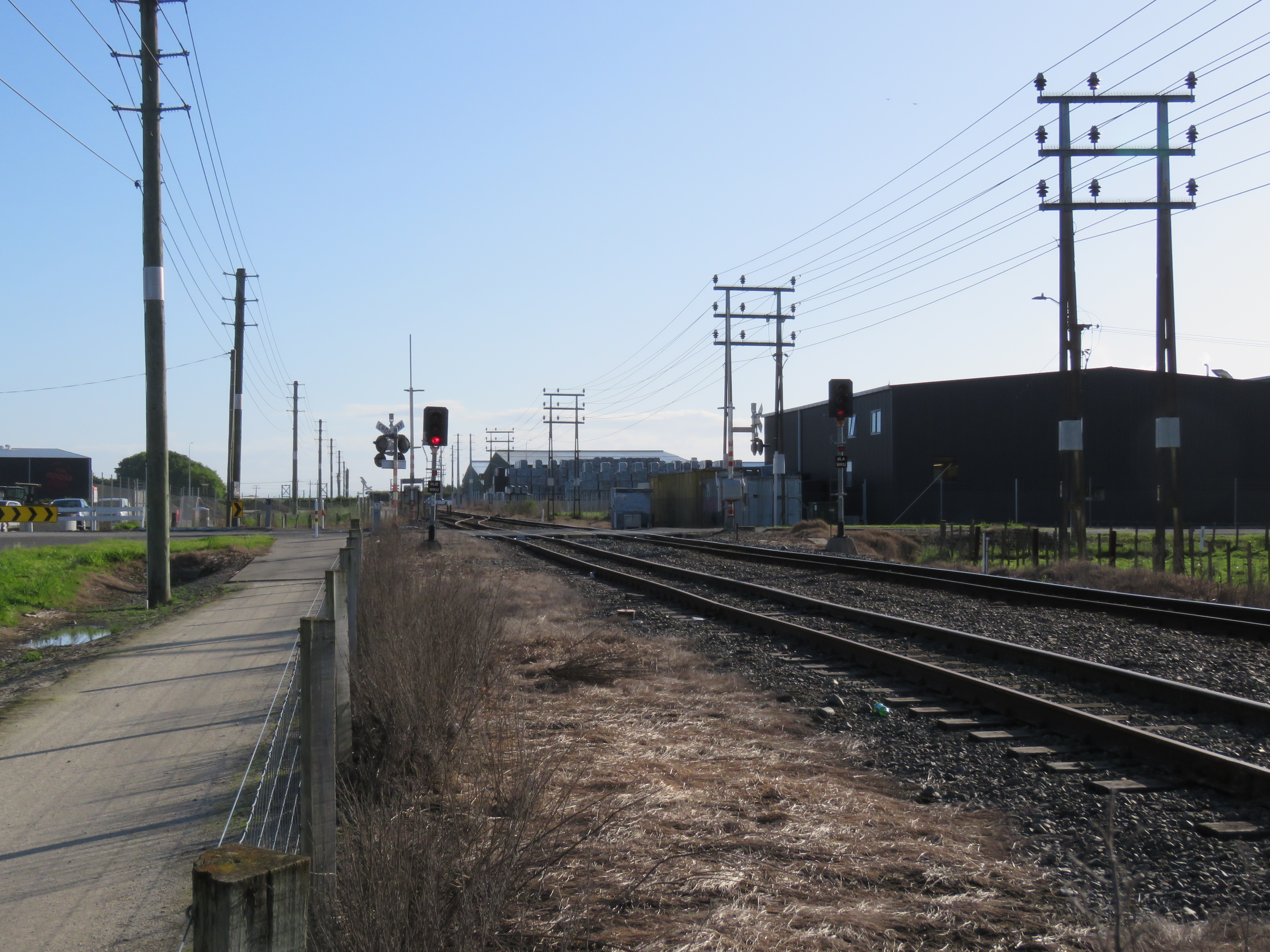
I started my exploration at the old Ruahapia Road railway level crossing at the western end of Whakatu. Ruahapia Road was one of the main arterial routes through this area but has been replaced by Te Ara Kahikatea, the Whakatu Arterial Route road. This allowed the railway level crossing to be closed although a pedestrian crossing remains.
Pedestrian crossing at the former Ruahapia Road railway level crossing. 4/10/22.
Looking west from the pedestrian crossing. The signal in the distance is the up distant approach signal for Tomoana, 4/10/22.From the pedestrian crossing you can access the iWay cycle and walk way that follows the railway line.
Directly to the east of the pedestrian crossing is bridge 212, a six span wooden trestle and steel girder bridge that crosses the Karamu Stream.
Bridge 212 over the Karamu Stream. One of the massive Turners and Growers cool stores can be seen in the background and the iWay swing bridge to the right. 4/10/22.Some of the trestles were receiving work at the time of my visit.
Trestles on Bridge 212 receiving some maintenance. 4/10/22.
To the east of the bridge, as the line curved towards Whakatu, there was a 40km/h speed restriction sign for DL locomotives crossing bridge 212 over Karamu Stream.
Speed restriction board for DL locomotives approaching bridge 212. 4/10/22.
At the end of the curve the railway straightens as it approaches the down home signal at the western end of the Whakatu loop.
The western approach to Whakatu Loop. 4/10/22.
The down home signal at the western end of the Whakatu Loop is a double aspect signal with a low speed light. The signal is one of the newer models that are being installed around the country. The signal lights are LED's and the pole has a hinge so the signal heads can be lowered to the ground to be worked on.
Home Signal 4R at the western end of the Whakatu Loop. 4/10/22.
Further to the east is the railway level crossing for Te Ara Kahikatea, the Whakatu Arterial Route road. This is one of the main arterial routes through Hawkes Bay. The new crossing is a huge improvement over the old railway level crossing on Ruahapia Road.
Te Ara Kahikatea, the Whakatu Arterial Route Road railway level crossing. Looking south. 4/10/22.
A little further to the east is the start of the Whakatu Loop. The loop itself is about 1.4 kilometers in length with sidings either side of the main and loop lines. the Hawkes Bay isn't my normal patch but the loop and signals appeared to be controlled by Centralised Train Control.
The mainline points and loop entrance at the western end of Whakau loop. 4/10/22.
The point motor at the mainline points at the western end of the Whakatu loop. 4/10/22.
Stop bank at the end of the western back shunt. 4/10/22.
Loop to Main points at the western end of the Whakatu Loop. 4/10/22.
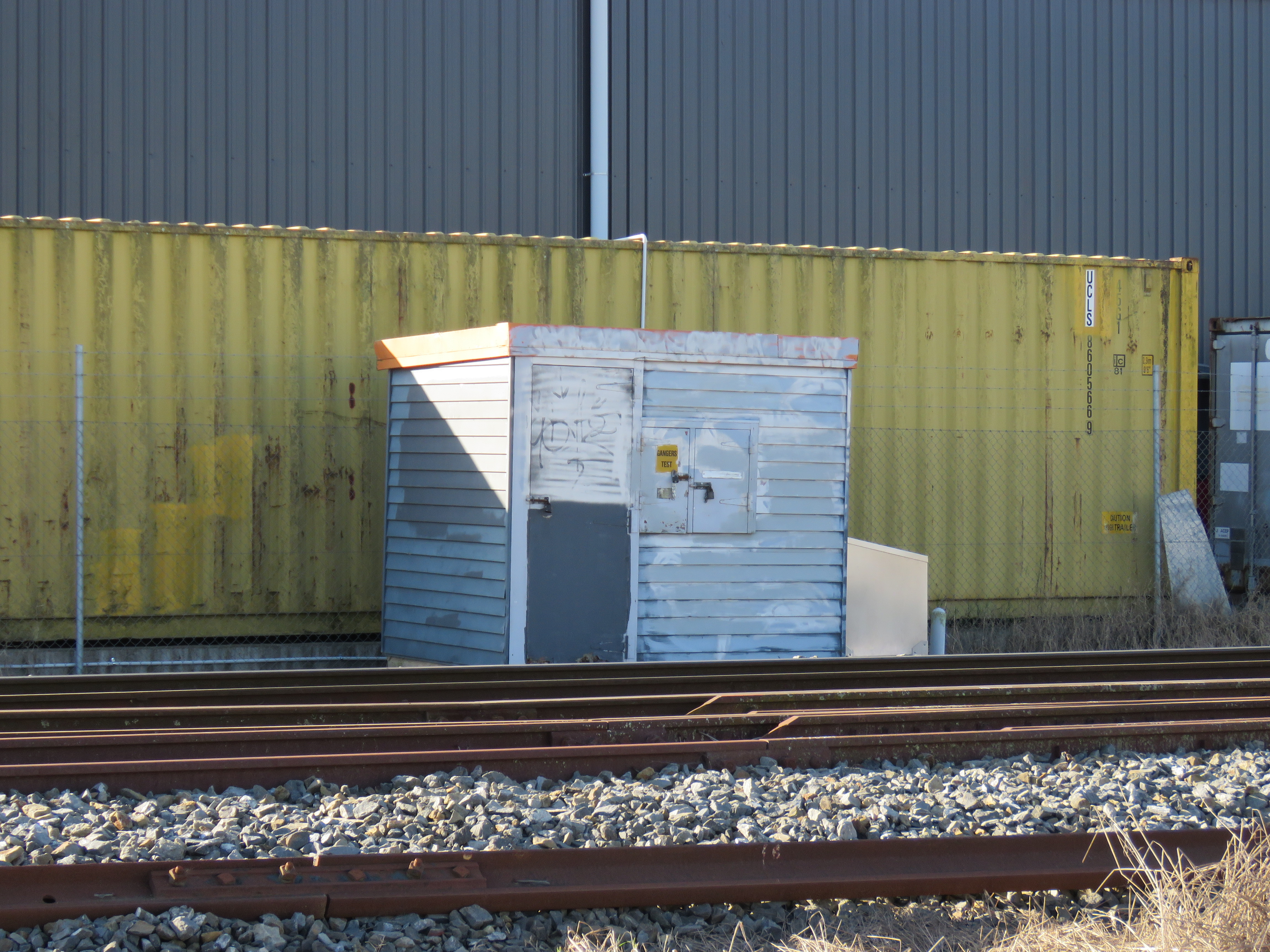
Signal hut at the western end of the Whakatu Loop. 4/10/22.
Another shot of the signal hut at the western end of the Whakatu Loop this time looking west. The Te Ara Kahikatea Whakatu Arterial Route Road railway level crossing can be seen in the background. 4/10/22.
Looking west from the Whakatu Road / Anderson Road railway level crossing. 4/10/22.
The Whakatu Road / Anderson Road railway level crossing looking south. The up main and loop departure signals can be seen on the left. 4/10/22.
Looking east from the Whakatu Road / Anderson Road railway level crossing. 4/10/22.
The up main and loop departure signals at the western end of the Whakatu Loop. 4/10/22.
The old freezing works at Whakatu created significant tonnage for the New Zealand Railways. Exchange sidings for the freezing works were located on the north side of the main line. Some of these sidings remain but I'm not sure how much use they get now.
End of the old freezing works sidings north of the mainline. 4/10/22.
The western end of the old freezing works sidings north of the main line. The loop is closest. 4/10/22.
The eastern end of the old freezing works sidings. 4/10/22.
Eastern end of the old freezing works sidings. Middle left is where some of the sidings entered the old freezing works site. Whakatu Station would have been in the foreground but is sadly no longer there. 4/10/22.
The main line points leading to the old freezing works sidings. 4/10/22.
The main line points leading to the old freezing works sidings on the north side of the main line. Another railway siding entrance to the old freezing works can be seen directly above the points. 4/10/22.
The freezing works had extensive sidings throughout the site. These sidings were worked by locomotives owned by the company.
In 1960, ex NZR steam locomotive D170 was replaced by A & G Price diesel locomotive number 197. D170 is now on display at the Helensville railway station.
There is a video of 197 at work in Whakatu in 2010 which you can find
here. I'm not sure if the locomotive is still in the works complex or if it is still in service.
A & G Price Locomotive 197 alongside steam locomotive D170 at Whakatu 1960. Photo courtesy of Knowledge Bank - Hawkes Bay Digital Archives Trust. knowledgebank.org.nz
In 1976, as part of a then $11 million dollar upgrade, a new cool store complex was opened on the south side of Anderson Road. The cool store remains in use and is still connected by a railway siding but looking at the tracks it has not been used for some time.
The points on the loop leading to the cool stores sidings on the south side of Anderson Road. 4/10/22.
The siding to the Whakatu cool stores. 4/10/22.
The railway level crossing warning signals on Anderson Road for the cool store sidings. This signal still has the old warning bell on the top.4/10/22.
Whakatu facing east from the cool stores siding. 4/10/22.
The Whakatu Cool Stores is an interesting complex in itself. I'll put up a blog post in the future with a more detailed look at this site.
Further to the east and against the old freezing works boundary is a Centralised Train Control (CTC) cabin. This cabin is constructed of concrete brick and is built to a standard New Zealand Railways design.
The Whakatu CTC Signal Cabin. 4/10/22.
While most of the boundary fence is covered by trees and other vegetation there are gaps where you can see the remaining freezing works buildings.
A lot of the buildings lasted into the early 2000's but being specially designed for processing animals and solidly built using brick, reinforced concrete and steel beams, it was hard for the buildings to be used for any other purpose. After years of remaining empty many of the buildings have now been demolished.
Demolition at the old freezing works is still underway. 4/10/22.
Another part of the old freezing works that still remains. 4/10/22.
At the eastern end of the Whakatu loop are the down departure signals for the main and loop. These signals are off set with the main departure a little further east than the loop departure signal.
Eastern end of the Whakatu Loop. 4/10/22.
The down main and loop departure signals at the eastern end of the Whakatu Loop. 4/10/22.
The down main and loop departure signals at the eastern end of the Whakatu Loop looking west. 4/10/22.
The signal hut at the eastern end of the Whakatu Loop. 4/10/22.
Like the western end of the loop there is also a short back shunt at the eastern end. Because the loop would have been used for shunting the cool store, these short back shunts were built to prevent wagons entering the main and causing damage if they ran away.
The mainline points at the eastern end of the Whakatu Loop. 4/10/22.
Directly to the east of the loop points is another level crossing leading to the old works site. This was one of the main entrances to the works.
In October 1986, when it was announced that the works were to be closed, a news camera captured workers entering the works for a final meeting. Parts of the level crossing can be seen in the news report
here. This crossing and entrance would have been an important one for the works as it separated the works from the works office on the corner of Anderson Road and Station Road.
An older part of the works building remains next to where the mainline curves to the north to cross the Clive River.
Once one of the main entrances to the old freezing works this railway level crossing now leads to a locked gate. 4/10/22.
Another railway level crossing warning signal with the old type warning bell. There can't be many of these still on a main line. 4/10/22.
The mainline curving away from Whakatu before crossing the Clive River. 4/10/22.
Unfortunately this was far as I could explore. It was starting to get late and I needed to get back to Napier. I'm not even sure I could get to the up home signal that was a short distance east of the level crossing and around the curve.
Whakatu lived up to my expectations of being as great place to explore some important New Zealand industrial history and to see the changes that have occurred to our rail network since the 1980's and 90's. If you're interested in railways and industrial buildings and you're lucky enough to be in Hastings or Napier, I would highly recommend a visit to Whakatu.
Thanks to the Hawkes Bay Digital Archives Trust and their Knoweldge Bank website for historic photos and information about Whakatu and the Hawkes Bay Farmers Meat Company.
You can find their excellent Knowledge Bank website
here.
And that's about it.