Saturday, October 15, 2022

Station Profile: Whakatu


An undated photo of the Whakatu Freezing Works mutton slaughterhouse. The Palmerston North to Gisbourne line can be seen in the foreground. Photo courtesy of Knowledge Bank - Hawkes Bay Digital Archives Trust. knowledgebank.org.nz An article on the building can also be found on the Knowledge Bank website here.

On a recent trip to Hawkes Bay I was able to sneak away for a few hours and explore Whakatu. Whakatu has always been a place of interest to me. When I was a kid I often passed through this industrial area during school holidays while helping Dad on his freight truck run. As we drove through I would get a glimpse of the imposing Whakatu Freezing Works and the cool store. Being a fan of New Zealand's industrial and railway history, Whakatu has always been a place I wanted to explore.

Whakatu is located at the 165 kilometer peg, between Hastings and Napier on the Palmerston North to Gisbourne Line (PNGL). This line is relatively busy with main line freights and shunts linking Hastings and Ahuriri and Napier Port.

Whakatu is best known as the location of the former Hawkes Bay Farmers Meat Company Limited freezing works.

Construction of the works began in 1913 and the killing of sheep commenced in January 1915. Huge demand for sheep, lamb and cattle meat during World War One meant the works were immediately profitable. The works continued to grow and became one of the largest freezing works in New Zealand. At its height the works had six chains operating and employed over 2000 people. The works exported around 95% of its production to more than 50 countries. The huge volume of sheep, lambs and cattle being processed meant the works were a major customer for the New Zealand Railways as many train loads of meat were taken to ports for export.

Hawkes Bay Farmers Meat Company Limited Whakatu freezing works in 1970. Photo courtesy of Knowledge Bank - Hawkes Bay Digital Archives Trust. knowledgebank.org.nz

On the 10th of October 1986 it was announced that the works would close. The news stunned the Hawkes Bay community. Whakatu, one of the largest and most profitable freezing works in the country would become a victim of the rationalisation of New Zealand's meat industry. Three days later on the 13th of October, 2000 workers were made redundant and left the works for the final time. The following year most of the remaining 60 staff, mainly maintenance and office staff were also made redundant as the site was taken over by Weddel. Less than ten years later, Weddel New Zealand went into receivership which resulted in the nearby Tomoana Freezing Works closing with the loss of another 2000 workers. A devastating loss for the Hawkes Bay.

Today Whakatu is a bustling industrial area. Most of the works have been demolished and a wide range of industries now operate in and around the old works site including massive fruit cool stores and warehousing facilities. Unfortunately none of these are served by rail. Trains now pass through Whakatu without stopping unless they need to cross another train.

Map of Whakatu

I started my exploration at the old Ruahapia Road railway level crossing at the western end of Whakatu. Ruahapia Road was one of the main arterial routes through this area but has been replaced by Te Ara Kahikatea, the Whakatu Arterial Route road. This allowed the railway level crossing to be closed although a pedestrian crossing remains.

Pedestrian crossing at the former Ruahapia Road railway level crossing. 4/10/22.


Looking west from the pedestrian crossing. The signal in the distance is the up distant approach signal for Tomoana, 4/10/22.

From the pedestrian crossing you can access the iWay cycle and walk way that follows the railway line.

Directly to the east of the pedestrian crossing is bridge 212, a six span wooden trestle and steel girder bridge that crosses the Karamu Stream. 


Bridge 212 over the Karamu Stream. One of the massive Turners and Growers cool stores can be seen in the background and the iWay swing bridge to the right. 4/10/22.

Some of the trestles were receiving work at the time of my visit.

Trestles on Bridge 212 receiving some maintenance. 4/10/22.

To the east of the bridge, as the line curved towards Whakatu, there was a 40km/h speed restriction sign for DL locomotives crossing bridge 212 over Karamu Stream. 


Speed restriction board for DL locomotives approaching bridge 212. 4/10/22.

At the end of the curve the railway straightens as it approaches the down home signal at the western end of the Whakatu loop. 

The western approach to Whakatu Loop. 4/10/22.

The down home signal at the western end of the Whakatu Loop is a double aspect signal with a low speed light. The signal is one of the newer models that are being installed around the country. The signal lights are LED's and the pole has a hinge so the signal heads can be lowered to the ground to be worked on.

Home Signal 4R at the western end of the Whakatu Loop. 4/10/22.

Further to the east is the railway level crossing for Te Ara Kahikatea, the Whakatu Arterial Route road. This is one of the main arterial routes through Hawkes Bay. The new crossing is a huge improvement over the old railway level crossing on Ruahapia Road.

Te Ara Kahikatea, the Whakatu Arterial Route Road railway level crossing. Looking south. 4/10/22.

A little further to the east is the start of the Whakatu Loop. The loop itself is about 1.4 kilometers in length with sidings either side of the main and loop lines. the Hawkes Bay isn't my normal patch but the loop and signals appeared to be controlled by Centralised Train Control.

The mainline points and loop entrance at the western end of Whakau loop. 4/10/22.


The point motor at the mainline points at the western end of the Whakatu loop. 4/10/22.


Stop bank at the end of the western back shunt. 4/10/22.


Loop to Main points at the western end of the Whakatu Loop. 4/10/22.


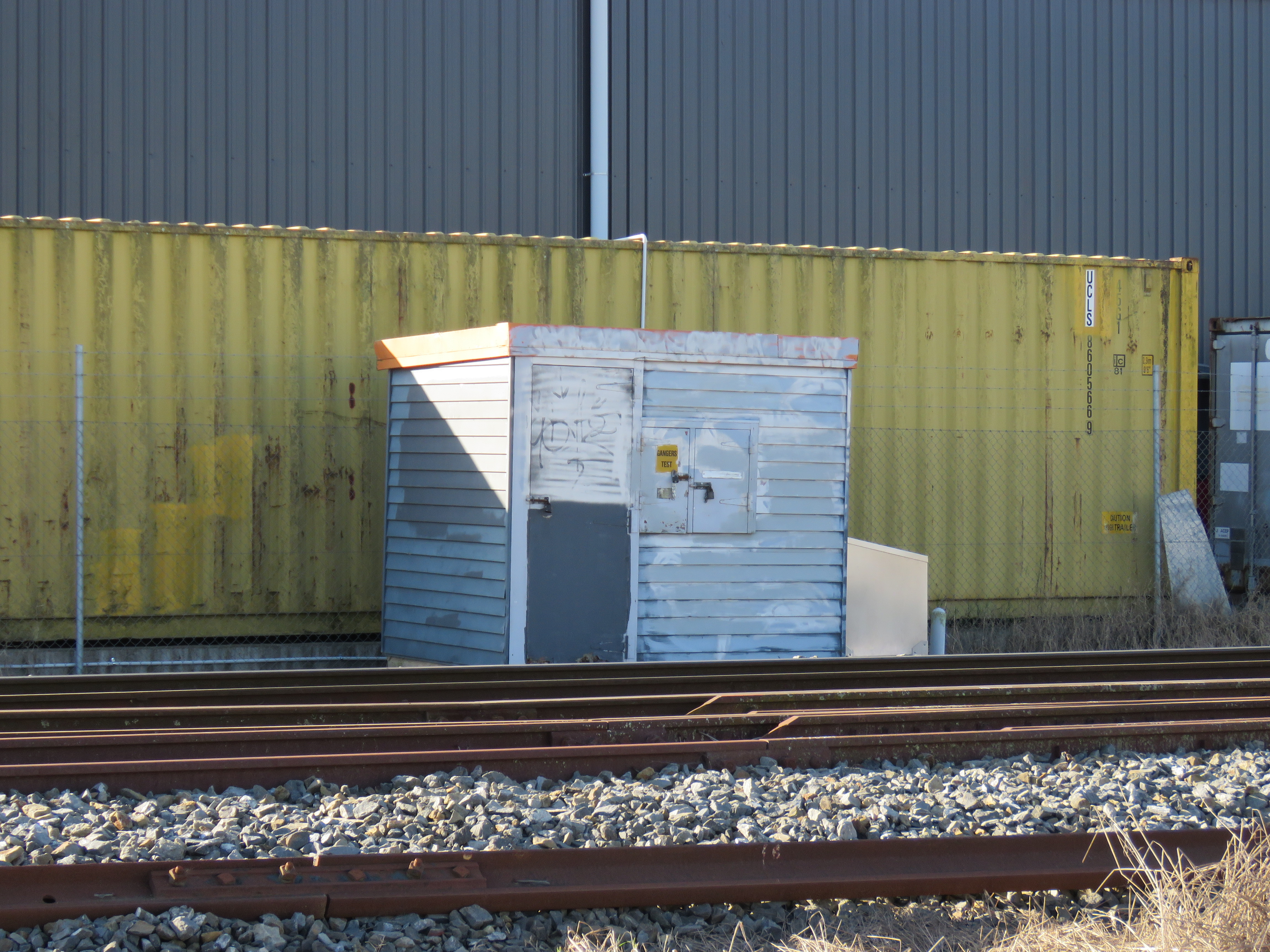
Signal hut at the western end of the Whakatu Loop. 4/10/22.

Another shot of the signal hut at the western end of the Whakatu Loop this time looking west. The Te Ara Kahikatea Whakatu Arterial Route Road railway level crossing can be seen in the background. 4/10/22.


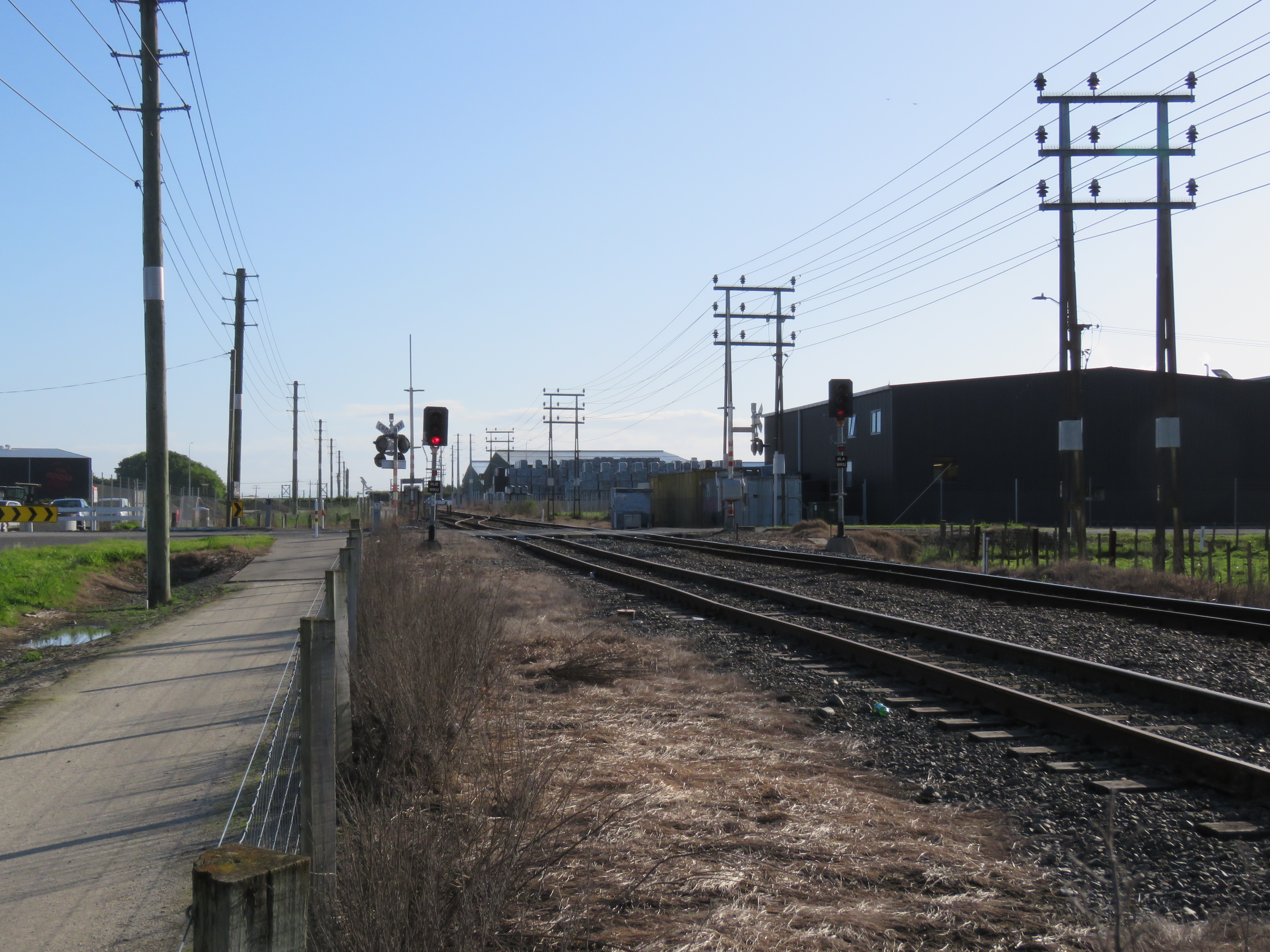
Looking west from the Whakatu Road / Anderson Road railway level crossing. 4/10/22.


The Whakatu Road / Anderson Road railway level crossing looking south. The up main and loop departure signals can be seen on the left. 4/10/22.


Looking east from the Whakatu Road / Anderson Road railway level crossing. 4/10/22.


The up main and loop departure signals at the western end of the Whakatu Loop. 4/10/22.

The old freezing works at Whakatu created significant tonnage for the New Zealand Railways. Exchange sidings for the freezing works were located on the north side of the main line. Some of these sidings remain but I'm not sure how much use they get now.

End of the old freezing works sidings north of the mainline. 4/10/22.

The western end of the old freezing works sidings north of the main line. The loop is closest. 4/10/22.


The eastern end of the old freezing works sidings. 4/10/22.


Eastern end of the old freezing works sidings. Middle left is where some of the sidings entered the old freezing works site. Whakatu Station would have been in the foreground but is sadly no longer there. 4/10/22.


The main line points leading to the old freezing works sidings. 4/10/22.


The main line points leading to the old freezing works sidings on the north side of the main line. Another railway siding entrance to the old freezing works can be seen directly above the points. 4/10/22.

The freezing works had extensive sidings throughout the site. These sidings were worked by locomotives owned by the company.

In 1960, ex NZR steam locomotive D170 was replaced by A & G Price diesel locomotive number 197. D170 is now on display at the Helensville railway station.

There is a video of 197 at work in Whakatu in 2010 which you can find here. I'm not sure if the locomotive is still in the works complex or if it is still in service.


A & G Price Locomotive 197 alongside steam locomotive D170 at Whakatu 1960. Photo courtesy of Knowledge Bank - Hawkes Bay Digital Archives Trust. knowledgebank.org.nz

In 1976, as part of a then $11 million dollar upgrade, a new cool store complex was opened on the south side of Anderson Road. The cool store remains in use and is still connected by a railway siding but looking at the tracks it has not been used for some time.


The points on the loop leading to the cool stores sidings on the south side of Anderson Road. 4/10/22.


The siding to the Whakatu cool stores. 4/10/22.


The railway level crossing warning signals on Anderson Road for the cool store sidings. This signal still has the old warning bell on the top.4/10/22.


Whakatu facing east from the cool stores siding. 4/10/22.

The Whakatu Cool Stores is an interesting complex in itself. I'll put up a blog post in the future with a more detailed look at this site.

Further to the east and against the old freezing works boundary is a Centralised Train Control (CTC) cabin. This cabin is constructed of concrete brick and is built to a standard New Zealand Railways design.


The Whakatu CTC Signal Cabin. 4/10/22.

While most of the boundary fence is covered by trees and other vegetation there are gaps where you can see the remaining freezing works buildings. 

A lot of the buildings lasted into the early 2000's but being specially designed for processing animals and solidly built using brick, reinforced concrete and steel beams, it was hard for the buildings to be used for any other purpose. After years of remaining empty many of the buildings have now been demolished.


Demolition at the old freezing works is still underway. 4/10/22.


Another part of the old freezing works that still remains. 4/10/22.

At the eastern end of the Whakatu loop are the down departure signals for the main and loop. These signals are off set with the main departure a little further east than the loop departure signal.


Eastern end of the Whakatu Loop. 4/10/22.


The down main and loop departure signals at the eastern end of the Whakatu Loop. 4/10/22.


The down main and loop departure signals at the eastern end of the Whakatu Loop looking west. 4/10/22.


The signal hut at the eastern end of the Whakatu Loop. 4/10/22.

Like the western end of the loop there is also a short back shunt at the eastern end. Because the loop would have been used for shunting the cool store, these short back shunts were built to prevent wagons entering the main and causing damage if they ran away.


The mainline points at the eastern end of the Whakatu Loop. 4/10/22.

Directly to the east of the loop points is another level crossing leading to the old works site. This was one of the main entrances to the works.

In October 1986, when it was announced that the works were to be closed, a news camera captured workers entering the works for a final meeting. Parts of the level crossing can be seen in the news report here. This crossing and entrance would have been an important one for the works as it separated the works from the works office on the corner of Anderson Road and Station Road.

An older part of the works building remains next to where the mainline curves to the north to cross the Clive River.


Once one of the main entrances to the old freezing works this railway level crossing now leads to a locked gate. 4/10/22.


Another railway level crossing warning signal with the old type warning bell. There can't be many of these still on a main line. 4/10/22. 


The mainline curving away from Whakatu before crossing the Clive River. 4/10/22.

Unfortunately this was far as I could explore. It was starting to get late and I needed to get back to Napier. I'm not even sure I could get to the up home signal that was a short distance east of the level crossing and around the curve. 

Whakatu lived up to my expectations of being as great place to explore some important New Zealand industrial history and to see the changes that have occurred to our rail network since the 1980's and 90's. If you're interested in railways and industrial buildings and you're lucky enough to be in Hastings or Napier, I would highly recommend a visit to Whakatu.

Thanks to the Hawkes Bay Digital Archives Trust and their Knoweldge Bank website for historic photos and information about Whakatu and the Hawkes Bay Farmers Meat Company.
You can find their excellent Knowledge Bank website here.

And that's about it.


Saturday, January 1, 2022

Magazine Round Up - Summer 2021.


Welcome to the Summer 2021 magazine round up. I've got my standard three essential magazines that I have happily read with a beer in the summer sun.


First up is the September 2021 edition of the NZ Model Railway Journal. Now I know what you might be thinking, this is the September Issue. Yes, yes it is. Unfortunately I haven't been able to get the December issue of this excellent magazine. 

The September Journal has an excellent range of articles and pictorials with a focus on way and works rolling stock. The journal includes articles on building a simple jig for soldering wires by Les Downey, basic benchwork using plywood by Peter Ross, a decoder tester, a stunning fell engine built using a 3D printed body by Karl Shields, an early way and works train at Little River, E class tank wagons and three on building E wagons. The magazine also has three pictorials including photos of a beautiful WA tank locomotive by Bryan Lawrence, a 50's focus on steam fell locomotive H 201 working on the famous Rimutaka Incline and vehicle views of non-revenue wagons in the 1950's and 70's.

I'll get the journal into the right order in the Autumn magazine round up.


Next up is the December 2021 edition of the Australian Model Railway Magazine. Another great magazine and this one is packed with great articles and photo's.

The December issue covers the late Rob Burford's triple-gauge South Australian layout Pirie, kit bashing a NSW Countrylink RDH coach, part 3 of Chris Jones's excellent Modelling Modern-era Containers, a look at the Logan District Model Railway Clubs brilliant layout of Wallon in HOn3 1/2, an excellent article by Michael Baum on Micro Layouts and painting realistic backdrops using spray paints.

The stand out for me was Michael Baum's article on micro layouts. I'm a big fan of micro layouts as they're a great way to develop your skills in a small space.


Last but not least is the summer edition of The Linesider. This relatively new magazine continues to get better and better. Like the the journal this edition has a focus on way and works on New Zealand's rail network. It's good to see this normally unseen work being covered. Normally the locomotives and rolling stock get all the love, but they aren't going anywhere without the hard work of the gangers.

Articles in the December edition include a fascinating article by Rob Webb called trackwork for beginners. Definitely the highlight for me. Other articles cover the end of NZR steam, the Kingston Flyer, a nostalgic look at the old Rails magazine, the Silver Star, Railcar Classroom and a short story by Max Kennelly with Bill Cowan recalling a stormy trip from Dunedin to Oamaru in 1975. 

There is also a good pictorial by D.L.A Turner documenting the running of the Kapiti Family Express hauled by JA 1271 and DA 1431 from Paraparaumu to Paekakariki and back on the 30th of May 2021.

Another interesting story was the purchase of 57 new locomotives for the South Island. The new dual cab, low emission diesel locomotives will be built by Stadler Rail Valencia from Spain and will replace the aging South Island fleet of DC, DFT and DX locomotives. This is big news for the South Island and something I might cover in a dedicated post later on in the year.

And that's about it.


Sunday, December 5, 2021

Accidentally Creative

DFT 7036 leads 934 Dunedin - Middleton Freight our of Herbert. 2/12/21.
 

While heading back to Oamaru I managed grab a quick and dirty shot of DFT 7036 leading 934 Dunedin - Middleton freight out of Herbert at the Irvine Road railway crossing.

In my rush I went to change the settings on my camera from auto to sports mode and instead ended up with creative but overall it didn't turn out to bad.

And that's about it. 

Tuesday, October 26, 2021

Oamaru Fuel Depots

An excellent Whites Aviation photo of the fuel depots and goods yard at Oamaru taken in 1956. National Library of New Zealand. https://natlib.govt.nz/ 

The township of Oamaru has always been a service town. From its earliest days to the present it has provided goods and services to farmers along the coast and inland up the Waitaki Valley. It also had good road, rail and sea transport links that were used to carry the vast amounts of wool, grain and meat produced in the district.

Petrol and other fuels were originally shipped in drums and tins but as the demand for petrol increased in the 1920's and 1930's oil companies began to develop bulk fuel distribution systems for their products. Petrol, Kerosene and other petroleum based products were imported into New Zealand by ship and stored in large fuel storage tanks at the major ports. It was then transported to smaller fuel depots around the country by coastal shipping, road or by rail. The fuel was then distributed to local outlets by truck. 

Like many other service towns in New Zealand, Oamaru had a number of small fuel depots. Three fuels depots were located at Friendly Bay in Oamaru Harbour. Operated by The Shell Company of New Zealand Ltd, Vacuum Oil Coy Pty Ltd (Mobil) and Caltex Oil N.Z. Ltd these depots were used to store and distribute fuel, oils and other petroleum based products across the Waitaki.

Oamaru Harbour in 1936. The relatively new fuel depots can just be seen in the middle of the photo. Whites Aviation - National Library of New Zealand. https://natlib.govt.nz/

A close up from the previous photo showing the Shell, Mobil  and Caltex fuel depots.

For the first few decades fuel and petroleum products were transported to the fuel depots by rail before being distributed by road. 

In 1953 Shell New Zealand completed construction of the large bulk fuel tanks at their depot and in December of that year their coastal oil tanker M.S. Tanea began calling at Oamaru Harbour. Fuel and petroleum products were unloaded at Holmes Wharf and transferred by pipeline to their tanks. 

Shell New Zealands Coastal Tanker M.S. Tanea. Photo from Helderline.com.

M.S. Tanea was a regular visitor over its eleven years of service with Shell in New Zealand. With the opening of Marsden Point oil refinery in 1964, new oil tankers were introduced on New Zealand's shipping routes. Unfortunately these new tankers were too large for Oamaru Harbour. M.S. Tanea continued calling at Oamaru until 1965 when Holmes Wharf was upgraded and the pipeline used to transfer fuel from the wharf to the Shell depot was removed.

For fuel transported by rail the fuel depots were served by a single dead end private siding that was located between the western boundary of the fuel depots and Oamaru goods yard. The siding was accessed from a set of points at the south end of the goods siding.

Section of 1971 Map of Oamaru showing the location of the fuel depots and siding. Lands and Survey Department - National Library of New Zealand. https://natlib.govt.nz/

A 1959 New Zealand Railways drawing showing the private siding for Caltex. Archives New Zealand - Dunedin Office.

A 1976 New Zealand Railways drawing of the new goods shed and yard alterations. The drawing shows the layout of the fuel depot siding. Archives New Zealand - Dunedin Office.

During my research I was only able to find documentation to show that Shell and Caltex used the fuel siding but couldn't determine if Mobil also used the siding.

Each of the fuel depots consisted of a variety of tanks and buildings for the storage of fuel and other petroleum products in bulk and in barrels and tins.  

An excursion train hauled by a small steam shunter D16 from the Waitaki Farmers Freezing Works at Pukeuri passes the fuel siding at the goods yard at Oamaru. Unknown date and photographer.

Shell had two large bulk fuel tanks at their site while Caltex had two smaller sized bulk fuel tanks. Documents from the archives show that Caltex unloaded tank wagons at their depot and later requested permission to install a raised platform to assist staff in unloading tank wagons.  

A 1965 letter from Caltex Oil (N.Z.) Ltd to the New Zealand Railways requesting approval to erect a raised walkway at their siding. Archives New Zealand - Dunedin Office.

In early 1981 New Zealand Railways approached Caltex and Shell asking if they wished to renew their private siding rights. Both Caltex and Shell declined to renew with Caltex also advising they would be closing their Oamaru Fuel Depot later in the year. After the siding rights expired on the 31st of May 1981 the private siding was closed.

Of the three fuel depots originally at Friendly Bay only one remains. McKeown Group is a fuel and chemical distribution business that operates from the former Shell and Mobil depot sites. The former Caltex site is now a camping ground.

While some of the area where the fuel siding was located has been redeveloped as a fuel stop there are still some interesting industrial and rail archeology to see.

Oamaru Steam and Rail's preserved railway line to Oamaru Harbour crossing Waterfront Road. The remains of the old connection leading to the goods yard and the siding for the fuel depots can still be seen in the road. 20/10/2021. 

The location of the private siding at the western side of the fuel depots. 20/10/2021.

The rear of the former Shell Fuel Depot at Oamaru Harbour. 20/10/2021.

Old pipe work still in the ground at the location of the bulk fuel tanks at the former Shell depot. 20/10/2021.

I have really enjoyed researching this part of Oamaru's industrial history. A big thank you to the staff at Archives New Zealand's Dunedin Office for dragging out old, dusty New Zealand Railways files, the Ministry of Culture and Heritage's New Zealand History website nzhistory.govt.nz and Gavin McLean for his excellent book Kiwitown's Port - The Story of Oamaru Harbour.

And that's about it. 


Friday, August 20, 2021

Lock Down Layout - Part 1 The Plan

With our sudden move to Alert Level 4 lock down and the opportunity to 'work' from home I thought now might be a good time to build a small lockdown micro layout. 

Since all my loco's are DCC I was going to put together a short programming track but why not make it into a proper layout. I've never built a layout to the scenicing stage. This will give me a great opportunity to practice all the different facets of model railways - bench work, track laying, DCC wiring, structure building and scenicing. Also by finishing a micro layout my wife will stop accusing me of buying stuff and not finishing anything.

The only downside is that I can only use what I have in the shed. 

A short internet search found a great plan that would work well as a micro layout, The track plan is Peco's Setrack OO Plan 30 - Locotec and Dewsbury Cement Terminal.


This plan is pretty simple and with a main and a single point leading to a siding. The original plan depicts a cement plant on the right hand side which can be shunted using both sidings and a goods shed on the right hand side that would receive wagons carrying machinery and other materials. At 122cm by 30cm (4' x 1') this is a good little layout that could be built fairly quickly.


I didn't have to look to far to find a Victorian prototype that would work with this plan. During my trip to Melbourne in 2016 I visited the Allied Flour Mill siding at Kensington. This is one of the last examples of broad gauge trains serving a Melbourne industry. 

I found some photos that I took on my visit in 2016 showing the mill. 


Unfortunately when I visited there was no train in the siding. So I had to search online to find these great photos of Kensington on the Wongm's Rail Gallery website. This is great resource of photos from around Melbourne and Victoria. You can find the Wongm's Rail Gallery website here.


The siding has a simple unloading operation. A loaded grain train arrives and starts to unload the first two wagons using an under track auger. When the first two wagons are unloaded the locomotive pulls the train forward positioning the second two loaded wagons over the auger. As these wagons start to unload the locomotive and first two now empty wagons cut off the train and move up the back shunt clear of the points. The points are set for the other siding and the loco pushes the two wagons back. The loco then cuts off the empty wagons and returns up the back shunt. The points are reset and the loco moves back onto the train. The train is again pulled forward with the third two wagons positioned above the auger for unloading. The loco and the second two now empty wagons are cut off before moving up the backshunt. This shunting sequence continues until all the wagons have been unloaded. 

A youtube video of the Kensington grain train shunting the flour mill siding can be found here

So the plan I have is something like this...


The layout differs from the siding at Kensington because it has a right hand point and not a left hand one. This is because I can only find a spare right hand point.. If I can find a left hand point I will use that to match the real thing.

And that's about it.

Sunday, August 1, 2021

The slightly delayed June Magazine Wrap Up


Like all railfans and railway modellers I'm an avid railway magazine collector. I've got who knows how many plastic boxes full of railway magazines.

Two magazines I've purchased over the last few months were the latest issues of the The Linesider and the NZ Model Railway Journal.


The Linesider 

First up is the Winter Quarter - June 2021 issue of The Linesider. As you can tell by the photo my copy already has some wear from being read cover to cover a few times. 

The Linesider has more than adequately filled the gap created when New Zealand Railfan ceased publication last year. While similar to NZ Railfan The Linesider is more of a pictorial magazine.

The June 2021 issue is the fourth issue since the magazine first entered book and hobby shops in 2020. Like the last three issues this magazine contains a range of articles and photos to keep any person with an interest in New Zealand's railways happily turning the pages.

This issue has a short article / pictorial about the recent heritage Great Southern Train Tour, an article about the last train to Tahakopa on the Catlins River Branch in 1971, an article and pictorial on the rebuild of the DB class diesel locomotives into the DBR class, an article on the recording of steam locomotive sounds, an excellent pictorial on New Zealand trains in winter landscapes, a good railfan story on capturing the last week of widespread use of diesel locomotive hauled and diesel multiple unit suburban passenger trains around the Auckland passenger network and the standard railfan news update.

As a fan of New Zealand railways in the 1980's the DB / DBR article and pictorial was my favourite in this issue. The highlight being the very good photos from well known railway photographer Dave Simpson. 

This is a high quality magazine which the Linesider team should be justifiably proud of. The magazine contains a large number of good quality photos and the articles are well written. As good as anything I have seen internationally.


NZ Model Railway Journal

The second magazine is the June 2021 issue of the NZ Model Railway Journal. This is the 414th issue of the magazine of the New Zealand Model Railway Guild.

As its name suggests this magazine looks at all things related to the modelling of New Zealand's railways. 

In this issue there is an article on the building of New Zealand general store, building an NZ120 (1:120) scale DXC locomotive in five (!) days, building a 1940's Chevrolet pick up and truck in 1:64 S scale, NZ Finescales wonderful new 'Addington' passenger carriage kit, a comprehensive article on NZR's 4-8-2 J class steam locomotives and building the JG Models legendary J class kit, another comprehensive article on the NZR 1897-1905 30 foot brake vans and an article on the recently released kit of these vans in 1:64 scale. The magazine ends with reports from the 9mm scene in New Zealand and the Christchurch NZR modellers' group, trade news and upcoming events.

Like The Linesider this is a high quality magazine and compares favourably with the more well known international railway modelling magazines.

Overall two great additions to my magazine collections.

And that's about it.

Tuesday, July 27, 2021

My name is Southern Rails and I'm a railfan.


DXB 5108 and DC 4323 lead Train 934 Dunedin - Middleton Freight north on the main at Merton. 24/07/21.

Last Saturday I decided to chase train 934 as it made its way north from Dunedin towards Christchurch. At this time of year the sun sits pretty low in the sky making photographing trains difficult but it would be a good way to kill a few hours and an opportunity to get a good coffee. The best photo I got was at Merton with the sun almost directly on the nose of DXB 5108 as it rounded the curve at Merton with 934. 

After happily clicking away at Merton I decided to head north to Tumai to catch 934 as it crested the Tumai bank and rounded the curve before heading beneath the overbridge. As I got near the Tumai turnoff I could see a car and two railfans, cameras at the ready at the spot I was going to stop at. I quickly decided to continue heading north to Palmerston. Unfortunately the sun was still too low so 934 was covered in shadows as it passed through Palmerston.

With my chase now a bust I started heading home and that's when I got to thinking. Why didn't I just turnoff at Tumai and park up next to the other railfans? I'm sure they got some great photos from a tried and true railfanning spot, a photo I'd now missed. 

Why is it the majority of railfans don't advertise the fact we take photos of trains, we model trains, we read about trains and watch videos of trains. Are we embarrassed? Worried about what others think? Is being a railfan not socially acceptable? Or is it just me? Do other people happily share what their hobby is with others?

When I look back on the Timaru model train show, the hall was packed with people of all ages. While most of them were families I would say a large number were 'train geeks' as my kids would say.

Something to ponder the next time I'm out railfanning.

And that's about it. 


Saturday, July 24, 2021

Model Railway Show: Alpine Energy Model Railway Expo, Timaru

The OO9 Scale Saxford Light Railway.

Last Saturday I managed to get to Timaru to visit the Alpine Energy Railway Expo. The show was held at Roncalli College Gymnasium. 

This was my first time going to this show and it was definitely worth the drive. There were 18 layouts on show with a mix of N, American and European HO, OO9, OO, G, large scale and even a huge Tomy Trains layout. All the layouts were great and built to a high standard.

The freelance scale HO scale Zealandia. This layout is based on a riverport in New Zealand and is set in the 1950's. 

This show is also a fundraiser for Hospice South Canterbury and last year raised $2500 for the hospice. A great effort by the organisers.

A train on the Christchurch Garden Railway Group's G scale floor layout.

Montigy is an HO scale French layout that is operated using digital control via a tablet.

040 Trains and Models from Ashburton and Toot Toot Trains from Invercargill had stalls at the show and looked to be doing some good business. You can find the websites for 040 trains here and for Toot Toot hereGood work to Toot Toot for making the long trek up from Invercargill. 

There were also some second hand stalls with model trains of varying quality, scales and eras for sale.

Train shows are one of the main ways we expose people to our awesome hobby. While there is a market for second hand trains I don't think having a table laden down with poor quality, old and crusty trains is the image we as a hobby are trying to portray. Imagine how disappointed you would be if you were new to the hobby and bought a loco, a few wagons, some track and an old controller and on getting home find they don't work or run poorly. On the other hand getting a loco, laying some track, hooking up a controller and running a train for the first time can be a fantastic feeling. Either way these stalls were very busy with model railroaders selling their unwanted items and others picking up some bargains. 

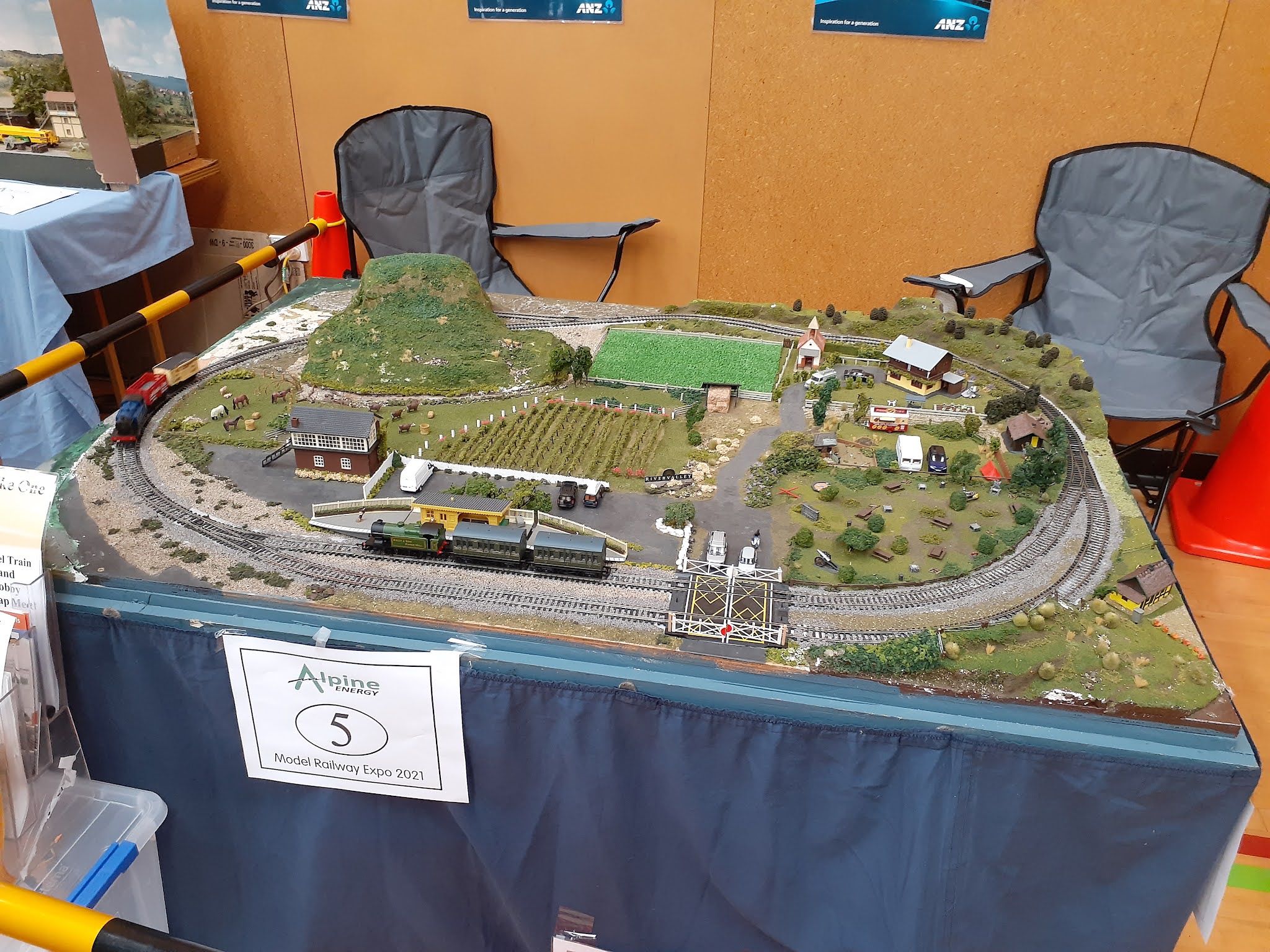
The OO scale River Valley railway.

Above and below: The HO scale Warnerville & Derrick Town layout. This layout is based in the 1950's and is divided into two scenes including a film set and an oil town.


The Marklin Modular Digital Group's German themed HO scale layout. I especially liked the smoke effects from some of the steam locomotives.

The HO scale Parklands County American diesel era layout.

The large Tomy Trains Galore layout. This brought back some great memories of playing trains with my son when he was a toddler. This layout would've chewed through a huge amount of AA batteries over the weekend.

Above and below: The freelanced N scale Eweburn Central Railway.


My favourite layout of the show was the OO9 scale Saxford Light Railway, a narrow gauge layout set in the early preservation era. This is a neat little oval layout that is still under construction. I'm a bit biased because I do like narrow gauge layouts. What surprised me is the amount of locomotives and rolling stock on the layout that were purchased ready to run. I look forward to seeing the progress of this layout.


Above and below: The OO9 Scale Saxford Light Railway.

The only negative I had was the lack of eftpos at the door. Other than that this was a great show. The gymnasium was packed with visitors and all seemed to be enjoying themselves which is always a good sign. Actually there were so many visitors I wasn't able to get good photos of some of the layouts. There also seemed to be a good number of people spending money at the trade stands. 

A big shout out to the organisers and all the modellers and stall holders that attended. It can be a big ask to travel, set up the layouts and stalls and man these throughout the weekend but you all did a great job.

I will definitely be back next year.

And that's about it.